Ali Speaks reader · The macro story in depth
Israel presents militant fundamentalist Islam with a problem that border negotiations alone cannot settle. The modern Jewish state is not only territory. It is the restoration of a people to political sovereignty in their ancestral land, the return of Jerusalem as the capital of a Jewish commonwealth, and the reappearance of the biblical story in public history.
A crisis created by sovereignty
For centuries, Jewish communities lived across the Islamic world without posing the same theological challenge. They could exist as protected but legally subordinate minorities under Muslim authority. The arrangement varied from one ruler and period to another, yet its governing hierarchy remained clear: Jews could live within an Islamic order, but they were not expected to rule independently over land that had once entered that order.
Zionism overturned that hierarchy. The Jewish people returned not merely as residents but as citizens, soldiers, legislators, and rulers of an independent state. Israel survived repeated attempts to destroy it, acquired military power, and established authority in Jerusalem. From the fundamentalist perspective examined in the article, the former subordinate has become sovereign.
This is why Israel’s persistence creates more than political frustration. It contradicts an account of history in which Islam is Allah’s final revelation and Islamic rule is expected to advance. Jewish restoration appears to point toward another account: covenant, return, Jerusalem, and the promises of the Hebrew Bible.
Jerusalem turns politics into sacred history
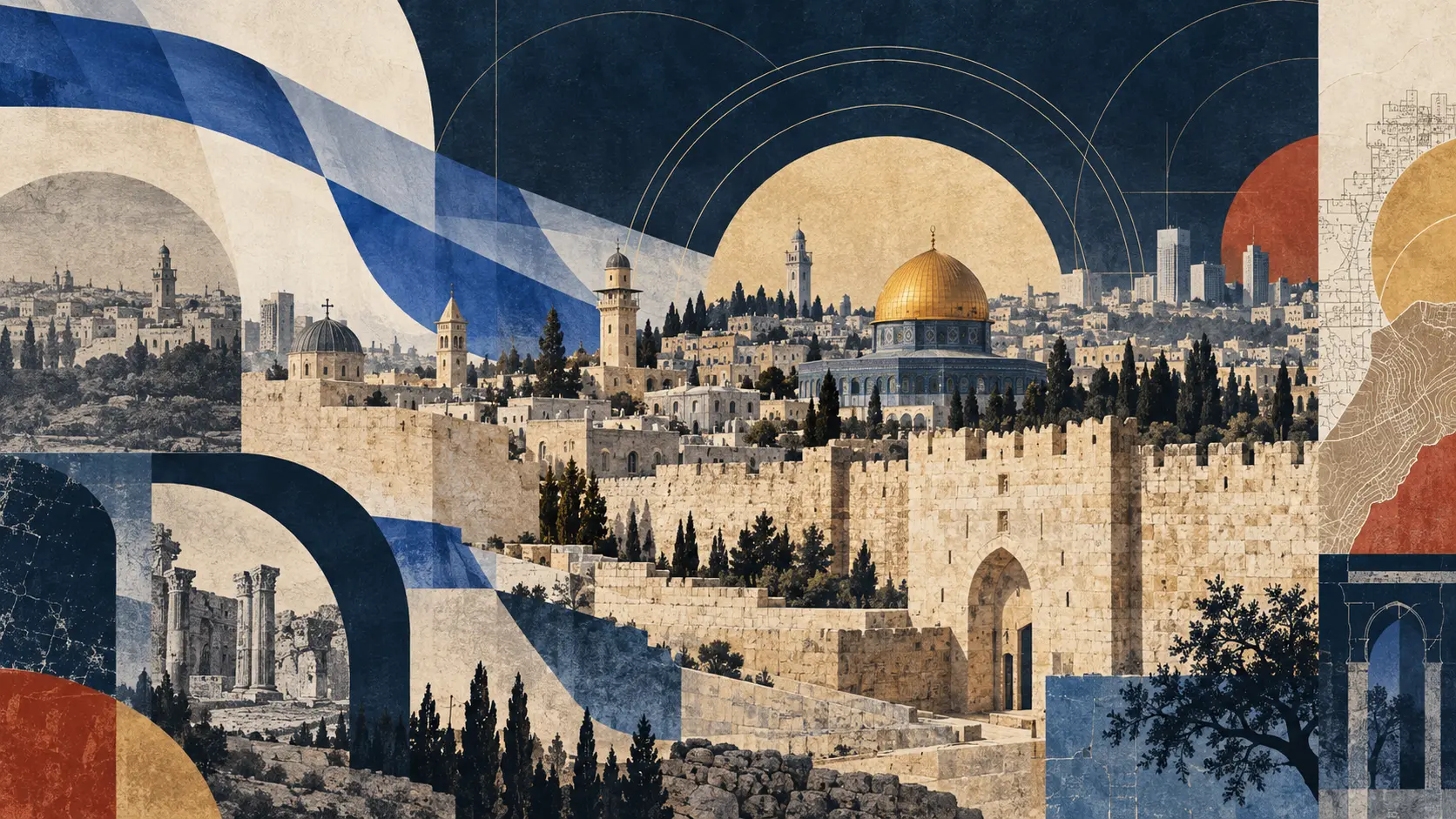
Jerusalem is where competing narratives become concrete. The city is not simply a capital or a disputed municipality. It carries the memory of Israel’s kings, the Temple, exile, return, Jesus, Islamic conquest, and the expectation of events still to come. Control of Jerusalem therefore becomes evidence about which sacred story is prevailing.
The political use of al-Aqsa illustrates this dynamic. In the twentieth century, Haj Amin al-Husseini helped recast conflict over immigration, national aspirations, and land as a defense of Islam’s sanctuaries. Claims that the Jews intended to seize or destroy al-Aqsa transformed political tension into religious emergency. The pattern endured because it provided a powerful theological frame: resistance to Jewish sovereignty could be represented as the defense of Islam itself.
Nearly a century later, Hamas named its October 7 assault “Al-Aqsa Flood.” The language placed a modern military operation inside that older sacred narrative. The site, the accusation, and the imagined duty remained bound together.
From precedent to revolutionary program
Fundamentalist movements do not interpret the present in isolation. They draw upon sacred precedents that identify actors, assign moral roles, and anticipate outcomes. The memory of Khaybar—where Muhammad’s forces conquered a Jewish stronghold—has consequently become a model for imagining Israel as a renewed Jewish fortress destined to face a returning Islamic army.
The same logic appears in eschatological traditions incorporated into Hamas’s founding covenant. The conflict is placed among the events preceding the Last Hour, making the destruction of Israel more than a national objective. It becomes a promised stage in the completion of sacred history.
Iran’s revolutionary regime has translated such memory into modern military language. Naming a missile “Kheibar Shekan” joins a seventh-century conquest to contemporary warfare. The name is an argument: ancient precedent is not past; it supplies a pattern for the present.
Iran adds a revolutionary horizon
The Islamic Republic brings together Persian state ambition, the revolutionary doctrines of 1979, and Twelver Shi’a expectation. Its regional network crosses the Sunni–Shi’a divide because the participants share a war against Israel and the Western order supporting it.
Within this framework, Israel’s defeat would not be treated as an ordinary geopolitical victory. It could be proclaimed as proof that the Islamic Revolution had correctly read the direction of history and placed itself at its leading edge. Israel’s survival frustrates that claim; Israel’s strength makes the theological contradiction visible.
The secular translation
After the Second World War, Soviet anti-Zionism supplied a second vocabulary. Zionism could now be described to Western audiences through the language of racism, colonialism, fascism, and imperialism. Older religious objections to Jewish sovereignty were translated into categories that secular institutions understood and repeated.
The result is a two-level discourse. Religious constituencies hear the language of sacred land, jihad, al-Aqsa, divine judgment, and the end of the age. Western constituencies hear the language of liberation, decolonization, and resistance. The vocabularies differ, but the political conclusion can remain the same: Jewish sovereignty is treated as uniquely illegitimate.
The question beneath the conflict
Israel therefore holds back more than armies. Its existence interrupts an ideological claim about the inevitable direction of civilization. Its possession of Jerusalem keeps open a rival reading of history—one beginning with Abraham, continuing through Israel and the prophets, and pointing toward a Messianic Kingdom rather than a restored Islamic order.
That is why diplomacy cannot fully resolve the argument. Beneath territory lies sovereignty. Beneath sovereignty lies sacred history. And beneath sacred history lies the question of which story Jerusalem will finally vindicate.